Intro
For almost every company, the AI wave hit without warning, sweeping over them like a tsunami. Playbooks from previous tech upheaval like the rise of the cloud or the SaaS revolution do not seem to help. Even established consulting firms lack a silver bullet, offering approaches that remain entirely theoretical.
Yet, in the aftermath of the initial impact, a clear path forward is slowly emerging, which we want to describe here. While it certainly requires some custom adaptation, this approach is already proving effective.
The core of this approach is an AI Triage system consisting of three parts:
- The AI Innovation Hub – Business Incubator and the supplier of ideas.
- The AI Center of Excellence (AICoE) acting as the advisor, steward, and translator similar to the role of a Cloud Center of Excellence (CCoE).
- The AI Factory serving as the engine room and implementer of the AI use cases.
This combination enables a company to escape the endless experimentation phase of merely playing around and writing prompts. It provides the structure needed to take real ideas and scale them enterprise-wide, both internally and externally. In this article, we will break down these individual roles and explore how they work together.
What is an AI Center of Excellence (AICoE)?
The AICoE is the strategic “Hub” of the organizations AI ecosystem. It is composed of a multidisciplinary team including Data Scientists, AI Engineers, AI Architects, AI Consultants, AI Product Managers and Ethics Officers who define the corporate AI vision. Its functional areas include:
- Strategy & Governance: The establishment of ethical guidelines and “Responsible AI” frameworks. This includes ensuring full compliance with international legal frameworks, such as the EU AI Act, and the continuous management of AI-specific organizational risks
- Resource Centralization: Serving as the primary broker for model selection (including Large Language Models and Small Language Models). The AICoE manages critical vendor relationships with hyperscalers and AI service providers to ensure architectural alignment.
- Internal AI Consulting: Functioning as the bridge between business needs and technical feasibility. This includes managing the onboarding process for new AI use cases, maintaining an AI use case inventory, and acting as internal consultants to help business units navigate the AI landscape.
- AI Asset Management: Providing oversight through central cataloging of all AI assets. It enforces a designated ownership model, identifying specific AI Managers (technical responsibility) and Data Owners (integrity and compliance) for every deployed solution.
- AI Cost Management: Comprehensive administration of AI-related finances. This encompasses budget planning, real-time monitoring of consumption, cost optimization of API/compute spend, and the identification of budget outliers.
- Enablement & Facilitation: Acting as a central engine for upskilling. The AICoE functions as a Training Facilitator, organizing internal and external programs, AI Weeks, and hackathons to close the skills gap across the workforce.
What is an AI Factory?
The AI Factory represents the technical and operational infrastructure managed by the AICoE. It is the industrialized “production line” where AI use cases are built, hosted, and maintained at scale. Similar to a Public Cloud Landing Zone, it provides a standardized service layer for AI applications.
Key components include:
- Centralized Model Hosting: A secure environment to serve proprietary or open-source models (e.g., Llama, Mistral) and managed APIs.
- Service Vending Machine: Providing “turnkey” AI services such as Personal Assistants (Copiloti), RAG-as-a-Service, and specialized model templates.
- Industrialization (AI Ops): Automated pipelines that move models from experimental sandboxes to robust, production-ready environments while enforcing technical controls and security guardrails.
What is an AI Innovation Hub?
The AI Innovation Hub is the business-driven engine focused on value creation and cultural transformation. While the AICoE governs and the Factory builds, the Innovation Hub identifies what should be built to transform internal processes and offerings.
Its mission includes:
- Business Transformation: Collaborating with departments to rethink business models and develop new AI-driven products.
- Bottom-Up Ideation: Sourcing ideas directly from the workforce to ensure innovation addresses real-world pain points.
- AI Literacy: Implementing company-wide programs to promote AI fluency, ensuring that staff—from executive leadership to front-line employees can effectively use AI agents to increase their personal effectiveness.
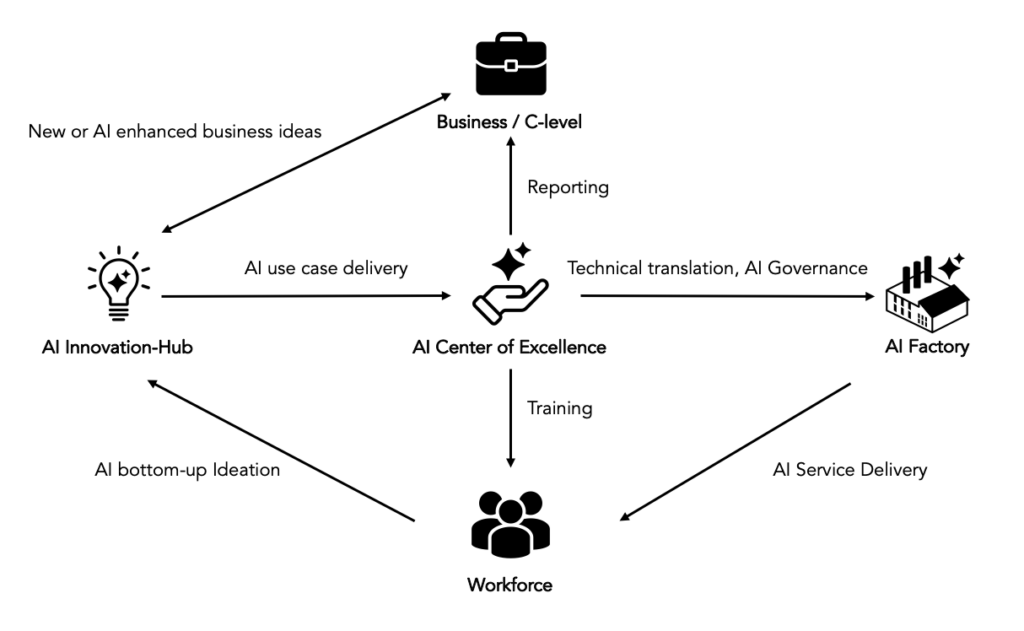
Interplay between AICoE, AI Factory, AI Innovation Hub, the Workforce, and the business
The Interplay of the AI Operating Model
The AI operating model functions as a multi-directional ecosystem between the Workforce, Business / C-level, Innovation Hub, AICoE, and AI Factory. This loop ensures that AI initiatives are strategically aligned, rigorously governed, and technically industrialized.
1. Strategic Ideation: C-Level and Workforce to Hub
The innovation pipeline is fueled by two streams:
- Bottom-Up: The Workforce identifies operational friction via AI Bottom-up Ideation.
- Top-Down: Business / C-level leadership injects New or AI-enhanced business ideas to drive long-term competitive advantage. The AI Innovation Hub centralizes these inputs, managing the AI Use Case Delivery to the AICoE for high-level vetting and prioritization.
2. Consultancy & Reporting: The AICoE as the Strategic Nexus
The AICoE acts as the organization’s AI Consultant, performing the Technical Translation of requirements. This involves:
- Service Architecture: Evaluating if a need fits existing services or requires a specialized architectural extension.
- Reporting: Providing continuous transparency back to the Business / C-level regarding project status, ROI, and compliance.
- Governance: Applying the “Responsible AI” framework, ensuring EU AI Act compliance, and enforcing the Agent Risk Classification (Personal, Company, or Critical Data).
3. Execution: AI Factory to Workforce
Once the AICoE provides the governed technical blueprint, the AI Factory takes over the industrialization. Through automated AI Ops and centralized hosting, it performs AI Service Delivery. These production-ready tools are deployed directly to the Workforce to enhance personal effectiveness and business output.
4. Enablement: The Training Loop
The AICoE completes the cycle by providing Training back to the Workforce. This continuous upskilling builds the AI Literacy required for employees to effectively use the Factory’s services and generate higher-quality ideation for the next cycle.
Don’t know where to start? – Consult me
I offer consulting services for setting up an AI Center of Excellence (AICoE) and an AI Factory, as well as building your first AI services. I also help you properly c